Nurse in France: IFSI training, the State Diploma and careers
The French route to becoming a nurse: the IFSI school, Parcoursup, the State Diploma, careers, pay and specialisations, plus how the qualification travels abroad.
Editorial team · Published on 23 July 2026
8 min read
Contents
- The nursing profession at a glance
- Daily life: duties and settings
- A typical day
- Studying to become a nurse: from the baccalaureate to the diploma
- Careers, employment and pay
- Who the job suits: qualities and interests
- An international perspective
- Bridges and changing course: a wrong turn is not the end
- Key takeaways
- Going further
Becoming a nurse means learning to care for, monitor and support patients, working independently over much of the care itself while staying in close contact with the doctor. It is one of the most in-demand health careers in France, and one of the most misunderstood when it comes to how you get in.
This profile describes the French route: the diploma, the schools and the admissions system are all French, and we explain each acronym as we go. The one myth to clear up straight away: no, you do not become a nurse by going through the first year of medical school. Many families picture a PASS or LAS year followed by a switch. The reality is simpler and more direct. You apply to an IFSI (institut de formation en soins infirmiers), one of France’s dedicated nursing schools, through Parcoursup, France’s national admissions platform, and the training lasts 3 years.
The sections below cover the real pathway, daily life across different settings, sourced pay figures, the specialisations open to you, and the kind of person the job actually suits. No overselling, and no hiding the constraints. A closing section looks at how the French qualification travels for international and expatriate families.
The nursing profession at a glance
A nurse delivers care, administers prescribed treatments, monitors patients’ condition, coordinates the care pathway and acts as a central link between the patient, the family and the medical team. The title is protected: you cannot practise without holding the State Diploma in Nursing (Diplôme d’État d’infirmier, or DEI) and being registered with the Ordre national des infirmiers, France’s nursing regulator.
The range of settings is wide: public hospitals, private clinics, self-employed community practice, the medico-social sector, school health, occupational health. Employment status follows: private-sector employee, civil servant in the public hospital service, or self-employed practitioner (a community nurse, known in French as an IDEL).
The qualification sits at bachelor’s level: the DEI carries degree grade (180 ECTS credits). For scale: according to DREES, the statistics office of France’s health ministry, more than 560,000 nurses were practising in France as of 1 March 2025. It is the largest health profession by headcount, well ahead of doctors.
Daily life: duties and settings
A nurse’s day depends heavily on the setting, but a few duties come up everywhere:
- Carrying out technical care: dressings, injections, drips, blood samples, fitting devices.
- Administering and monitoring prescribed treatments, spotting adverse effects.
- Watching patients’ clinical condition (vital signs, pain, changes) and alerting the doctor.
- Keeping records: the care file, written and spoken handovers to the team.
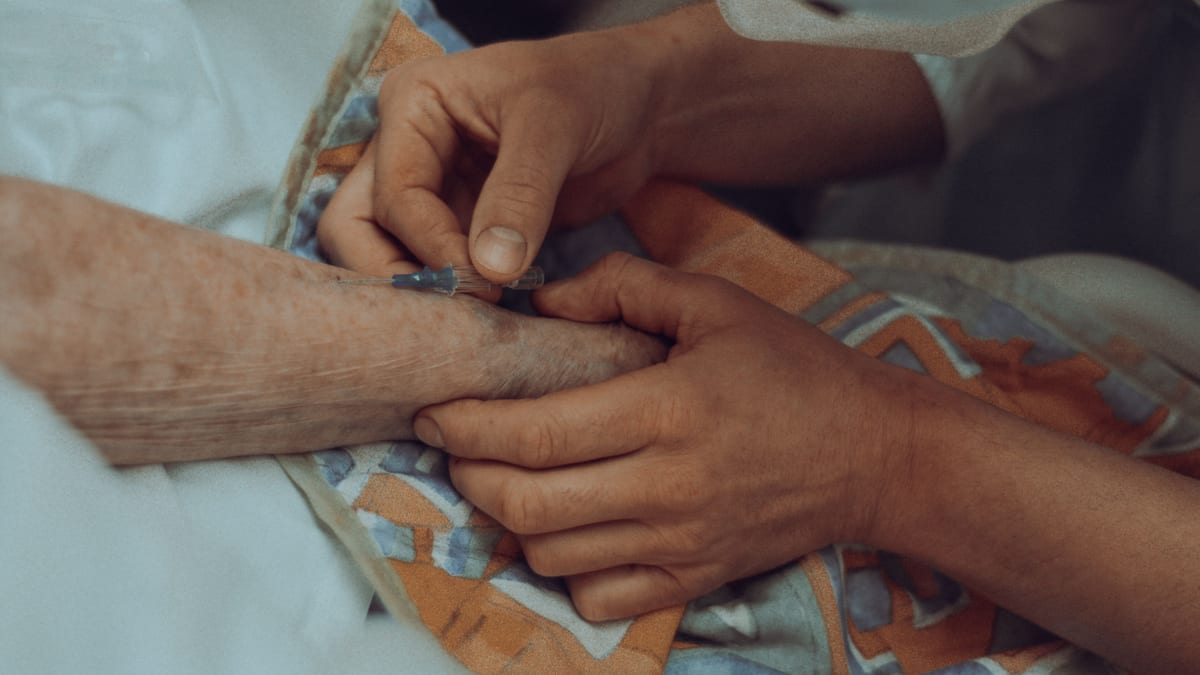
- Supporting and informing patients and their families, including through difficult moments.
- Coordinating the care pathway with care assistants, doctors and other professionals.
The setting changes everything. In a hospital, you work as a team, often on rotating shifts with nights and weekends, under heavy workload. In community practice, you run a round of home visits on your own, with an entrepreneurial side (billing, admin). In a school or a workplace, the rhythm is steadier, focused on prevention, occasional emergencies and listening.
A typical day
Take a made-up example. Sarah, a nurse on an internal medicine ward, starts her shift at 6:45 am. She takes the night handover, prepares and gives out the morning medication, runs fasting blood tests, and monitors two patients on drips. Mid-morning she joins a doctor on the ward round, adjusts care and reassures an anxious patient before a procedure. The afternoon mixes dressings, admissions, coordinating discharges and writing up the care file. She hands over to the next team around 2:30 pm. The pace is intense and the responsibility constant, but every action has a tangible point.
Studying to become a nurse: from the baccalaureate to the diploma
The pathway is clear. After the baccalaureate, you apply to an IFSI through Parcoursup, on the strength of your file (school reports, plan, motivation letter). No speciality is compulsory, but IFSI panels value candidates comfortable with life and earth sciences (SVT) and physics-chemistry, with good written expression and a genuinely mature plan. Motivation and a coherent file weigh heavily.
The training lasts 3 years, organised into 6 semesters and 4,200 hours of teaching (2,100 hours of theory and 2,100 hours of clinical placements), plus around 900 hours of personal study. It leads to the State Diploma in Nursing, which carries bachelor’s grade. To be clear: the nurse route goes through neither PASS nor LAS. Those pathways (the shared first year of medical studies) lead to medicine, pharmacy, dentistry, midwifery and physiotherapy.
Alternative routes: qualified care assistants with experience can, under conditions, access the training through specific bridges. Some adults retraining also enter an IFSI through continuing professional education.
| Stage | Duration | Diploma / step |
|---|---|---|
| Final year of school + Parcoursup application | 1 year | IFSI choice, file review |
| IFSI training | 3 years | State Diploma in Nursing (degree grade) |
| Registration with the Ordre | Immediate | Authorisation to practise |
| Specialisation (optional) | 1 to 2 years | IADE, IBODE, paediatric nurse or IPA |
Careers, employment and pay
The market clearly favours graduates. Nursing is among the most sought-after occupations in France (source: France Travail), with recruitment pressure in most regions, especially in hospitals and in care for older people. Newly qualified nurses are hired quickly, often before they have even finished their studies.
On pay, in the public hospital service a newly qualified general-care nurse earns roughly 2,000 euros gross per month in 2025 (the fixed pay scale, before premiums), on top of which come night, Sunday and public-holiday premiums, plus the pay rises from the Ségur de la santé reform. Pay rises with seniority and can pass 2,500 euros gross mid-career, more later on or with added responsibilities. In self-employed community practice, income varies widely with activity and patient base.
| Situation | Indicative pay (gross monthly, 2025) |
|---|---|
| Newly qualified nurse, public hospital | around 2,000 euros |
| Experienced nurse, public hospital | around 2,500 euros and up |
| Self-employed community nurse | variable with activity |
On progression, you can specialise after a few years: IADE (nurse anaesthetist, 2 years, master’s grade), IBODE (operating-theatre nurse, 2 years, master’s grade), paediatric nurse (1 year, by competitive entry, for children), or IPA (advanced practice nurse, a 2-year university master’s with a broadened scope). You can also become a healthcare manager, an IFSI trainer, or a coordinating nurse.
Who the job suits: qualities and interests
The work calls for rigour (a dosage error is not an option), composure, real physical and mental stamina, and a strong sense for human contact. You work with suffering, sometimes emergency, occasionally death. Emotional endurance counts as much as technical skill.
Honest downsides: shift work and weekends weigh on personal life, especially in a hospital early on. The workload and the confrontation with distress can wear you down. This is not a job for anyone seeking a strictly desk-bound setting or predictable days.
If caring appeals but you are still torn between several health pathways, it can help to set the plan out clearly. An orientation review helps you weigh your taste for care, your tolerance for the hours and the alternatives (physiotherapy, midwifery, medicine) before locking in a Parcoursup choice. Our overview of health careers opens that reflection without rushing the decision.
An international perspective
Because nursing is a regulated health profession, the French qualification travels better than most. General-care nursing is one of the seven so-called sectoral professions with automatic recognition across the EU and the wider European Economic Area under Directive 2005/36/EC, alongside doctors, dentists, midwives, pharmacists, veterinary surgeons and architects. In practice, this means the French State Diploma in Nursing is recognised automatically in other EU/EEA member states: a French-trained nurse can register and practise elsewhere in the EU without having the diploma reassessed on its academic merits, subject to the host country’s procedural and language requirements. That is a genuine advantage, and one that few other French diplomas share.
Two caveats keep this honest. First, “automatic recognition” covers the qualification, not the paperwork: you still register with the host country’s nursing regulator, prove language competence, and follow local practice rules. Second, outside the EU/EEA there is no automatic mechanism. In the United Kingdom, the United States, Canada, the Gulf states and elsewhere, a French nurse must apply to the national regulator, often sitting a language test and a competency or licensing exam. Recognition is possible and common, but case by case, never a given.
So who is the French route right for? It makes strong sense for a family already inside the French or AEFE school system, for a teenager who sits the French baccalaureate, and for anyone who plans to practise in France or elsewhere in the EU. The EU-wide portability turns a French diploma into a European one. If, on the other hand, the plan is to train in France but build a career in the United States or the Gulf, factor in the extra licensing step from the start, and compare it honestly with training in the country where you intend to work.
Bridges and changing course: a wrong turn is not the end
Nothing is fixed. A nurse can move into a neighbouring role (healthcare manager, trainer, coordination) or shift to a different way of practising (self-employed after the hospital, or the reverse). Conversely, a care assistant can join an IFSI through a bridge, and a student disappointed by a first year of health studies can move across to nursing care.
Neighbouring professions are worth a look before deciding: the physiotherapist (another rehabilitation profession, but with a different entry route), the midwife, the care assistant, or the radiographer. Each answers a different sensibility about care.
Key takeaways
- Required diploma: State Diploma in Nursing (Diplôme d’État d’infirmier), compulsory to practise, with registration on the professional register.
- Duration: 3 years in an IFSI (6 semesters, 4,200 hours of teaching), bachelor’s grade.
- Entry route: application on file through Parcoursup. No PASS, no LAS.
- Market: high demand, quick entry to work, more than 560,000 nurses practising (DREES, 2025).
- Pay: around 2,000 euros gross per month at the start of a public hospital career (2025), before premiums.
- Watch point: shift work, nights, weekends and emotional load, especially early on.
- International: automatic EU/EEA recognition of the French diploma under Directive 2005/36/EC; outside the EU, expect a national licensing step.
Going further
- The career profiles hub of the Axiom guide
- Career profile: physiotherapist
- Career profile: midwife
- Career profile: radiographer
- European Commission: Regulated Professions Database (Directive 2005/36/EC)
- Ordre national des infirmiers, France’s nursing regulator
Written by the Axiom Orientation team.
Frequently asked questions
Do you have to go through PASS or LAS to become a nurse?
How long does nurse training take in France?
Which baccalaureate and which subjects help for an IFSI?
Is it easy to find work as a nurse?
How much does a newly qualified nurse earn?
Read more

Career profiles: exploring French careers by field to find your path
Axiom's directory of career profiles: start from the job to build a solid path, with the real French entry route, honest prospects and an international angle.
10 min read
Midwife in France: Training, the Diploma and Career Paths
The French route to becoming a midwife: PASS or L.AS, the State Diploma of Doctor of Midwifery, career paths, pay and who the job suits.
9 min read
Physiotherapist: the French route through PASS or STAPS
The French route to becoming a physiotherapist: access to the IFMK via PASS, L.AS or STAPS, the State Diploma, daily work, prospects and pay.
9 min read

Becoming an AI Engineer in France: Studies and Prospects
Becoming an AI engineer in France: bac+5 studies, the scientific foundation required, honest prospects and pay. An Axiom career profile.
11 min read
Photo credits: Stéf -b. · Pexels · source