Radiographer in France: the DEMEM and DTS IMRT diplomas
The French route to becoming a radiographer: the DEMEM and DTS IMRT diplomas, Parcoursup entry without PASS or LAS, a high-demand profession, pay and mobility.
Editorial team · Published on 23 July 2026
10 min read
Contents
- The radiographer profession at a glance
- Daily life: tasks and settings
- A typical day
- Training: from the baccalaureate to the diploma
- Careers, employment and pay
- An international perspective
- For which profile: strengths and interests
- Bridges and changes of direction: getting it wrong is not fatal
- Key takeaways
- Going further
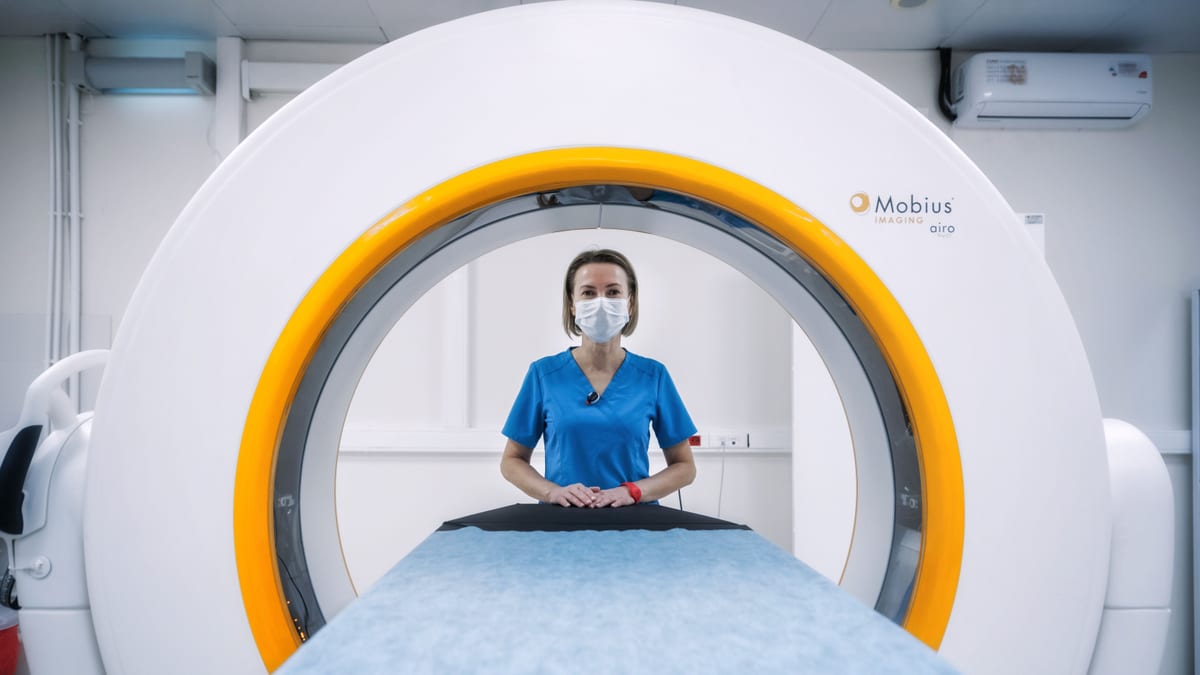
The medical electroradiology technician, known in English simply as a radiographer, is one of the quiet mainstays of imaging and radiation medicine. This is the person who actually carries out the X-rays, CT scans, MRI scans, nuclear medicine examinations and radiotherapy sessions, under a doctor’s responsibility but with wide technical autonomy.
This profile describes the French route into the job, and the French route has a particular quirk: two different diplomas lead to exactly the same profession. The entry system, the diplomas and the acronyms are all French, and we explain each one as we go. One myth is worth clearing up straight away. Many families picture a year of medical school followed by a switch. The reality is more direct: you apply after the baccalaureate, through Parcoursup, to one of the two diplomas that lead to the job. It is a field where work is currently plentiful, to the point that the public authorities speak of a lasting shortage.
The sections below set out the real pathway, the two possible diplomas, daily life across different settings, sourced pay figures and the kind of person the job suits. No overselling, and no hiding the constraints. A closing section looks at how the French qualification travels for international and expatriate families, because the answer is more nuanced than for most French health diplomas.
The radiographer profession at a glance
A radiographer carries out the examinations and treatments that use radiation or imaging: conventional radiology, CT, MRI, ultrasound, nuclear medicine, radiotherapy. They position the patient, set up the equipment, manage radiation protection, produce the images and keep the records, in constant contact with the radiologist, the oncologist or the nuclear medicine physician. Practice is reserved to holders of a recognised diploma: you cannot call yourself a radiographer without one of the two State-regulated diplomas.
The range of settings is wide: public hospitals, private clinics and radiology centres, cancer treatment centres, private practices. Employment status follows: civil servant in the public hospital service or private-sector employee, with self-employed practice remaining marginal in this profession.
The qualification sits at bachelor’s level (three years after the baccalaureate). For scale: according to DREES, the statistics office of France’s health ministry, 31,298 radiographers were practising in France as of 1 January 2022, about three quarters of them women. An Igas report of March 2021 noted a historical overestimate of these numbers and confirmed a profession under strain.
Daily life: tasks and settings
The day-to-day depends heavily on the equipment on hand, but several tasks recur everywhere:
- Welcoming and positioning the patient, explaining how the examination will go, reassuring them.
- Setting up and operating the equipment (radiology table, CT scanner, MRI machine, radiotherapy accelerator).
- Ensuring radiation protection for the patient, the team and themselves.
- Running the acquisitions, checking image quality, preparing and injecting contrast media on prescription.
- Monitoring the patient’s condition during the examination and alerting the doctor when needed.
- Keeping records and carrying out first-level maintenance of the machines.
The setting changes everything. In a hospital, you work in a team, often on shift patterns with on-call duty and weekends, and a share of emergencies. In a private radiology centre, the pace is steadier, built around a flow of scheduled examinations. In radiotherapy, you follow patients across the whole length of a treatment, which builds a relationship over time. In nuclear medicine, you handle radioactive products under strict protocols.
A typical day
Take a fictional example. Karim, a radiographer in a hospital imaging department, starts his shift at 7:30 am. He begins with the machines’ quality checks, then works through the scheduled examinations: abdominal CT scans, X-rays, a knee MRI. Mid-morning he handles an emergency from intensive care, adjusts the settings for a patient with limited mobility, keeps an eye on the dose. The afternoon mixes fitting lines for contrast injections, supporting anxious patients and passing the images to the radiologist. A steady pace, constant technical precision, and real human contact at every examination.
Training: from the baccalaureate to the diploma
This is the key point of the profile: two distinct diplomas lead to the same job, with the same practising rights.
The first is the State Diploma in Medical Electroradiology (Diplôme d’État de manipulateur d’électroradiologie médicale, or DEMEM), taught over 3 years in an IFMEM (institut de formation de manipulateurs d’électroradiologie médicale), a radiography training institute attached to a university. It carries bachelor’s-degree level. The second is the Higher Technician Diploma in Medical Imaging and Therapeutic Radiology (Diplôme de technicien supérieur en imagerie médicale et radiologie thérapeutique, or DTS IMRT), also taught over 3 years, but in a lycée (a French upper-secondary school). Both programmes run to about 4,200 hours split between theory and clinical placements.
In both cases, entry is after the baccalaureate, through Parcoursup, decided on your file. The DTS IMRT usually adds a motivation interview. No single subject is strictly required, but the programmes value science profiles: physics-chemistry fits particularly well (the job rests on radiation and imaging), alongside life and earth sciences (SVT) and mathematics. One thing to state clearly: radiographers do not go through PASS or LAS. Those routes lead to medicine, pharmacy, dentistry, midwifery and physiotherapy.
| Step | Duration | Diploma / stage |
|---|---|---|
| Final year of school + Parcoursup application | 1 year | IFMEM choice (DEMEM) or lycée choice (DTS IMRT) |
| Training, DEMEM route | 3 years | State Diploma, bachelor’s-degree level, in an IFMEM |
| Training, DTS IMRT route | 3 years | Higher Technician Diploma, in a lycée |
| Entry to work | Immediate | Practice in a hospital or a private centre |
Careers, employment and pay
The market is clearly favourable. The profession is officially recognised as a shortage occupation: an Igas report of March 2021 calls it under strain since 2017, carried by the momentum of cross-sectional imaging (CT, MRI), interventional radiology, radiotherapy and nuclear medicine. The AFPPE, the professional body for electroradiology staff, put the number of unfilled posts in departments at more than 2,000. New graduates find work quickly, in hospitals and in the private sector alike.
On pay, in the public hospital service a newly qualified radiographer earns roughly 1,900 to 2,100 euros gross per month in 2025 (index-based pay scale, before premiums), with night, Sunday and public-holiday supplements on top. Pay rises with seniority and can pass 2,500 euros gross in mid-career. In the private sector, the shortage pushes pay higher, with gaps that can be significant between employers.
| Situation | Indicative pay (gross monthly, 2025) |
|---|---|
| Newly qualified radiographer, public hospital | around 1,900 to 2,100 euros |
| Experienced radiographer, public hospital | around 2,500 euros and above |
| Radiographer, private sector | often higher, varies by employer |
As for progression, you can specialise (ultrasound, MRI, CT, radiotherapy, nuclear medicine), become the lead on a technical platform, or, after four years’ experience and dedicated training, move into health manager (cadre de santé) roles and then care direction (through the EHESP public health school). Continuing education and the dosimetrist role open other bridges.
An international perspective
This is the part expatriate and binational families should read closely, because for radiographers the answer is more encouraging than for most French paramedical diplomas, though still not automatic.
Start with the rule that catches people out. Radiography is a paramedical health profession, and it is not one of the professions covered by automatic recognition across the EU and EEA under Directive 2005/36/EC. That directive grants automatic recognition to a short list of regulated professions (doctor, nurse responsible for general care, midwife, dentist, pharmacist, veterinary surgeon and architect). Radiographers are not on it. So the French diploma does not carry an automatic right to practise the same job elsewhere in Europe.
The good news is that, unlike some very France-specific paramedical roles, the profession has a clear, regulated equivalent almost everywhere. Diagnostic and therapeutic radiographers exist across the English-speaking world: in the United Kingdom the title is protected and you must register with the HCPC (Health and Care Professions Council); in the United States and Canada the equivalent is the radiologic technologist, with state licensure and certification (for example through the ARRT). That makes the skills genuinely portable in substance, even if the paperwork is not automatic.
What that means in practice:
- Within the EU and EEA, the French diploma is recognised under the general system, handled case by case by the host country’s competent authority. Recognition is common, but it can come with compensation measures (an aptitude test or an adaptation period) and language requirements.
- In the UK, North America, the Gulf or Asia, you apply to the local regulator, which assesses your training against local standards and often asks for a registration exam or a period of supervised practice. The equivalent job is well established, so the route usually exists, but it runs through the destination country’s own licensing.
- In all cases, the sooner you check the host country’s requirements, the better, because some ask for specific modules (for example in radiation protection or in a given imaging technique) that are easier to plan for during training than after.
So who is the French route right for? It makes clear sense if your family is in the French or AEFE school system and heading towards the French baccalaureate, and if the plan is to practise in France or elsewhere in the EU. Because the profession also exists as a regulated equivalent abroad, the French diploma travels better than a France-only paramedical qualification, provided you accept a recognition step in the destination country. If, on the other hand, you already know you will build your career in the United States, the United Kingdom or the Gulf, it is worth comparing the French route with training directly for the locally licensed profession (radiologic technologist, diagnostic radiographer) in the country where you intend to work. The honest advice is to match the route to the family’s real geography.
For which profile: strengths and interests
The job calls for rigour (radiation protection and dose leave no room for approximation), technical precision, a real ease with complex machines and a genuine feel for contact, because you support patients who are often anxious and sometimes very ill. The ability to work in a team and handle the unexpected counts for a lot in a hospital.
Honest counter-indications: shift work, on-call duty and weekends weigh on personal life, especially in a hospital. Facing serious illness, particularly in oncology, takes emotional resilience. This is not a job for anyone looking for a strictly office-bound setting or wary of technology.
If imaging and care appeal but you are torn between several paramedical routes, it can help to lay the plan out clearly. A guidance assessment helps you test your appetite for care, your tolerance for shift patterns and the alternatives (nurse, physiotherapy) before locking in a Parcoursup choice. Our career profiles and our choice-support tools open that reflection without rushing the decision.
Bridges and changes of direction: getting it wrong is not fatal
Nothing is fixed. A radiographer can move towards management (health manager, platform coordination), teaching in an IFMEM, or specialised technical roles such as dosimetry. Conversely, a student disappointed by a first year of health studies or a science degree can redirect towards this profession, whose mix of the technical and the human often appeals.
The neighbouring professions are worth a look before deciding: the nurse (another care profession, entered through an IFSI nursing school), the physiotherapist, or the medical laboratory technician. Each answers a different sensibility about care and technology.
Key takeaways
- Qualifications required: State Diploma in Medical Electroradiology (DEMEM, in an IFMEM) or Higher Technician Diploma in Medical Imaging and Therapeutic Radiology (DTS IMRT, in a lycée).
- Duration: 3 years in both cases (about 4,200 hours), bachelor’s-degree level for the DEMEM.
- Entry route: application on file through Parcoursup, with an interview for the DTS. No PASS or LAS.
- Market: shortage occupation confirmed by Igas (March 2021), quick entry to work, 31,298 radiographers practising (DREES, 2022).
- Pay: around 1,900 to 2,100 euros gross per month at the start of a career in a public hospital (2025), before premiums, with the private sector often paying more.
- International note: outside EU automatic recognition, but a regulated equivalent exists in most countries, so the qualification travels through a case-by-case recognition step.
- Watch points: shift work, on-call duty and weekends in a hospital, exposure to serious illness in oncology.
Going further
- The careers hub of the Axiom guide
- Career profile: nurse
- Career profile: physiotherapist
- European Commission: recognition of professional qualifications in the EU
- ONISEP: medical electroradiology technician (in French)
Written by the Axiom Orientation team.
Frequently asked questions
Do you have to go through PASS or LAS to become a radiographer?
What is the difference between the DEMEM and the DTS IMRT?
Which baccalaureate subjects help for this profession?
Is it easy to find work as a radiographer?
How much does a newly qualified radiographer earn?
Read more

Career profiles: exploring French careers by field to find your path
Axiom's directory of career profiles: start from the job to build a solid path, with the real French entry route, honest prospects and an international angle.
10 min read
Nurse in France: IFSI training, the State Diploma and careers
The French route to becoming a nurse: the IFSI school, Parcoursup, the State Diploma, careers, pay and specialisations, plus how the qualification travels abroad.
8 min read
Physiotherapist: the French route through PASS or STAPS
The French route to becoming a physiotherapist: access to the IFMK via PASS, L.AS or STAPS, the State Diploma, daily work, prospects and pay.
9 min read
Becoming an AI Engineer in France: Studies and Prospects
Becoming an AI engineer in France: bac+5 studies, the scientific foundation required, honest prospects and pay. An Axiom career profile.
11 min read
Photo credits: Max Mishin · Pexels · source