











 France
  English
  United Arab Emirates
  España
  Россия
  中国
中国 Parcoursup Explained: Applying to French Universities as an International Student
Think of Parcoursup as the French UCAS or Common App: one national platform for entering French higher education. Here is how it works for international students, from the calendar to the application file.

If you know UCAS in the United Kingdom or the Common App in the United States, you already understand the idea behind Parcoursup: one national platform through which almost every application to the first year of French higher education passes. For international students, and for families whose children attend French schools abroad, it is the main gateway to a system that combines highly regarded programmes with public tuition fees that remain modest compared with most English-speaking destinations. Here is how the platform works, what the calendar looks like, and what applicants educated outside France need to prepare.
Where does Parcoursup come from?
The need for a central admissions platform in France goes back to the late 1990s. At the time, enrolling at a French university was largely a matter of first come, first served.
A first platform, Admission Post-Bac (APB), was launched in 2009 by the Ministry of Higher Education and Research to help final-year students apply to the first year of higher education in France. Some of its features quickly drew criticism from the student rights association Droit des Lycéens, in particular the requirement to rank choices and the opaque use of a Gale-Shapley matching algorithm. APB was retired in 2017, with the stated aim of no longer making decisions about individuals on the sole basis of an algorithm and of bringing more transparency to the process.
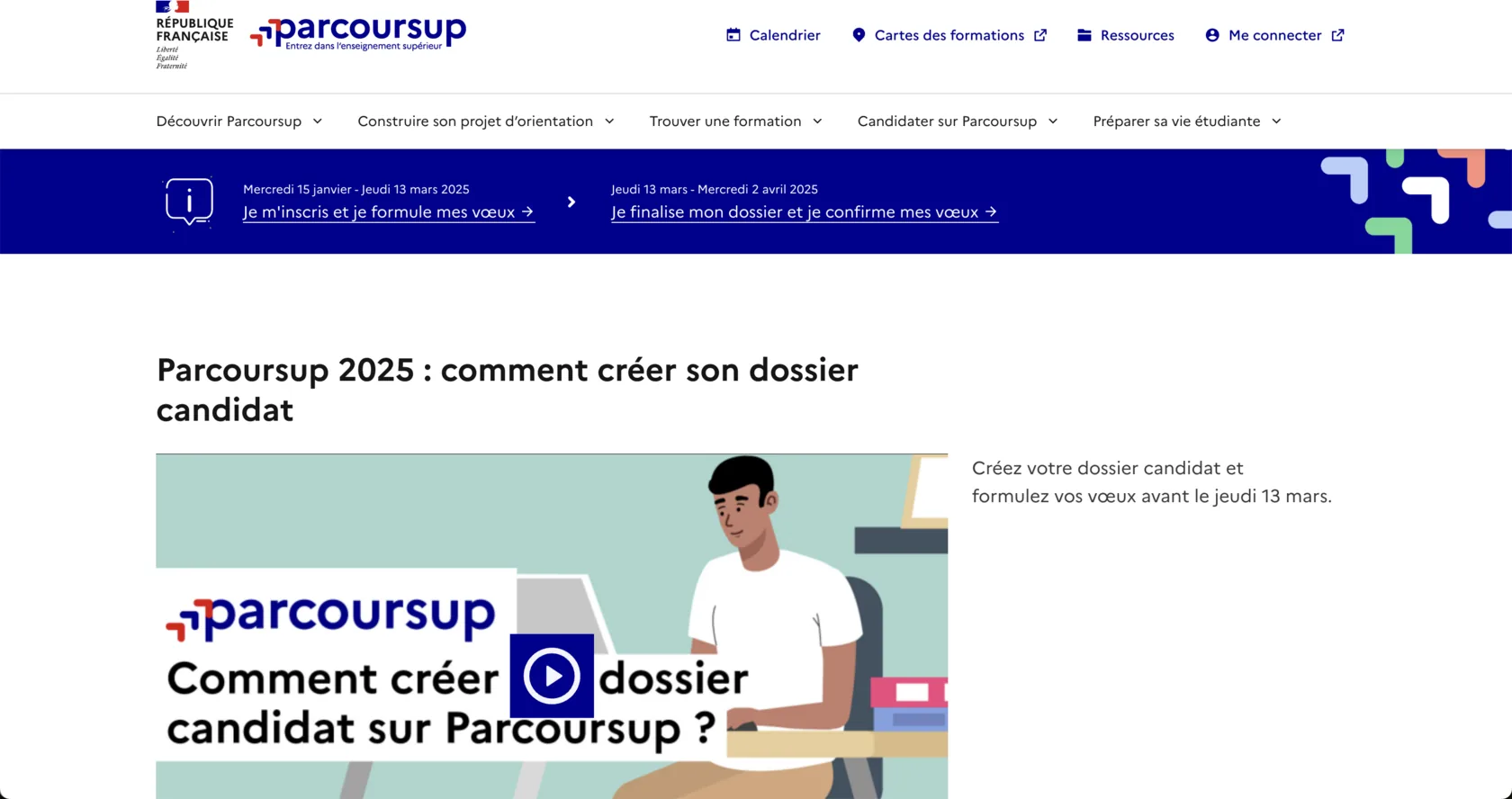
Parcoursup was created on 15 January 2018 by the French Ministry of Education and the Ministry of Higher Education, Research and Innovation. Unlike many admissions services elsewhere, it is a non-commercial, ad-free public service: a French government administration headquartered on rue Descartes in Paris. It is the national pre-registration platform for the first year of higher education in France, and it has kept improving since its launch, adding tutorials and videos for a growing number of candidates and listing close to 24,000 programmes in 2024.
What does Parcoursup actually do for applicants?
For a secondary school student, Parcoursup works first as a powerful search engine, with filters for location, field of study, level and more. It also gives access to detailed programme pages (course description, success rates and so on), which makes side-by-side comparison much easier. Finally, it is where candidates submit their choices, called “vœux” (wishes), track their applications against a precise calendar, receive an individual answer for each choice and, if needed, formulate new ones.
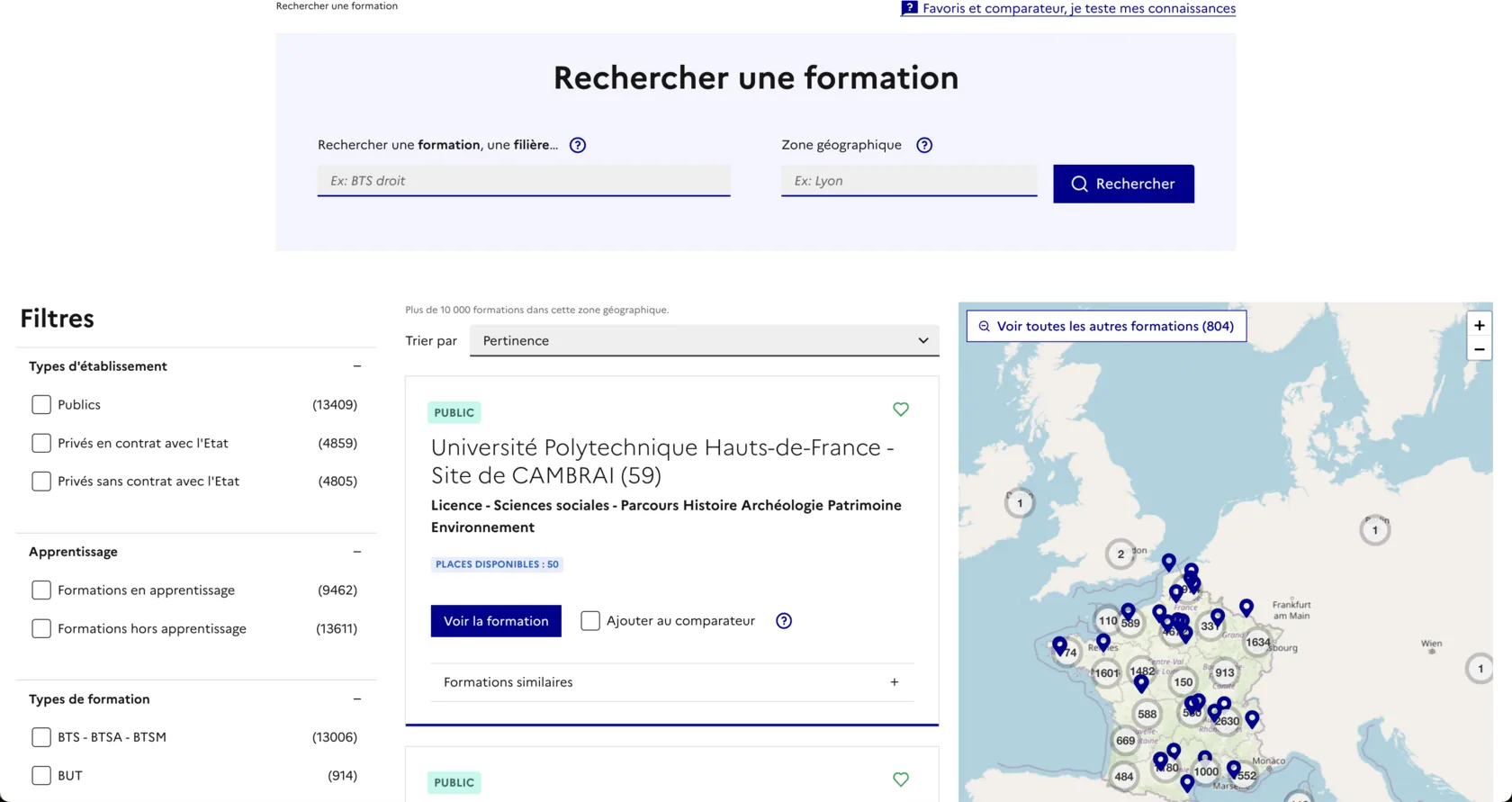
Source: screenshot from the official Parcoursup website (www.parcoursup.fr)
How does it compare with UCAS, the Common App and other systems?
In much of Europe (Spain, Italy, Denmark, Switzerland), no such national platform exists: students contact each university directly and follow a separate calendar for every programme.
Other countries have adopted centralised platforms comparable to Parcoursup: the Netherlands with Studielink, Ireland with the CAO, Germany with Hochschulstart. The differences lie in which programmes are covered, how many choices you can make and when applications open. The UK’s famous UCAS platform, for instance, demands serious anticipation, since files must be submitted between September and January of the final school year. Parcoursup runs later in the year, which can be an advantage for students applying to several countries at once: it is entirely possible to build a UCAS application in the autumn and a Parcoursup application in the winter of the same school year.
One notable difference from UCAS: on Parcoursup, choices are not ranked. Each programme examines your file without knowing where it sits in your order of preference.
The Parcoursup calendar, step by step
Each year, there are three main stages in the official calendar for final-year students.
From November to January, the platform is open for research and discovery. A key date in December (18 December 2024 for the current cycle) is usually described as “the opening of the programme map”. In reality the platform is already accessible before that: a student in the two years before their final year, or anyone curious about French higher education, can create a “favourites” account and save interesting programmes. When that student reaches their final year, their shortlist is waiting for them. The December date really corresponds to the annual refresh of the catalogue, since new programmes join every year and admission procedures evolve.
Then comes the period from January to April, when candidates register, submit their choices and complete their files. For students enrolled in France or in a school belonging to the AEFE network (the French state agency for French schools abroad), the process is streamlined: the school provides the national student identifier (INE), uploads school reports directly (grades, class ranking, subject-by-subject teacher comments) and completes the “fiche Avenir”, a school assessment covering the candidate’s working methods (autonomy, attitude, diligence, perseverance) and their capacity to commit to the programme applied for. For students attending a school outside the AEFE network, this stage takes more time: the candidate enters their own academic record and must translate teachers’ comments if they were written in a language other than French. This is, in practice, where diploma and transcript equivalence gets handled, so international applicants should start early.
Once the choices are submitted, students who applied only to non-selective programmes move to the main admission phase from June to July. During this phase, candidates receive answers from programmes and make their final decision. After that, only one formality remains: administrative registration directly with the chosen institution.
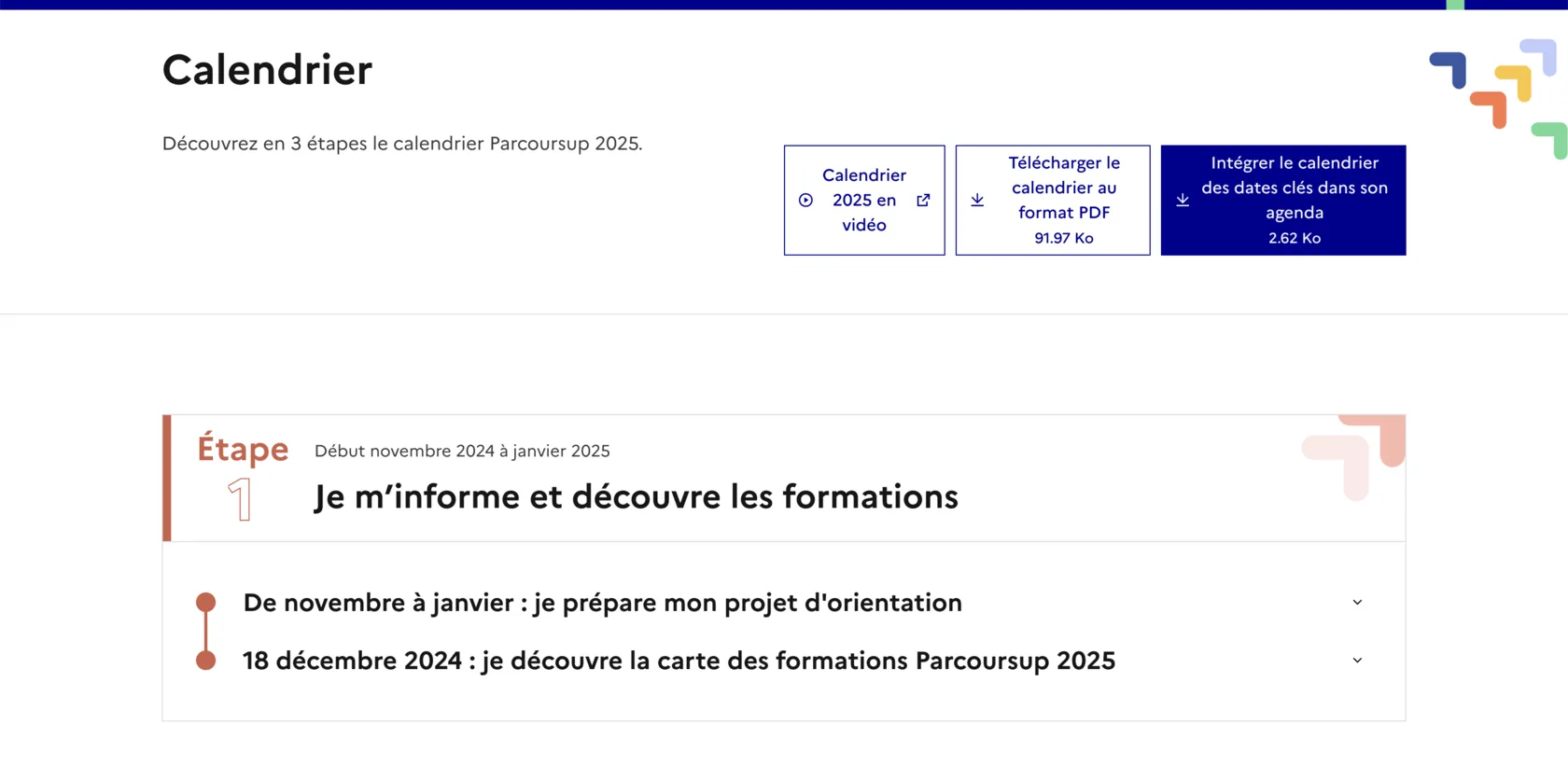
Source: screenshot from the official Parcoursup website (www.parcoursup.fr)
What if you apply to selective programmes?
Then the period from April to June becomes intense: this is when selection tests take place. They can be joint entrance exams shared by several schools (engineering, business and others), written papers or motivation interviews. Every selection procedure is described in the programme’s information sheet on Parcoursup. Before adding a selective programme to your list, it is essential to understand its selection process and, ideally, to prepare for it in advance, for example with mock interviews, to put every chance on your side. This matters all the more for international applicants, since these selective tracks (the “classes préparatoires”, engineering and business schools, and other grandes écoles pathways) are precisely where French higher education concentrates much of its academic excellence.
What goes into the Parcoursup file you must complete before April?
Before the choices themselves, some elements of the file are compulsory, such as school reports and the section called “Préférence et autres projets”: a 1,500-character text stating the type of programme you want, your preferred field of study and your desired geographic area. This section is confidential and only accessible to the Commission for Access to Higher Education (CAES) during the complementary admission phase. It only comes into play if all of your choices are refused.
Other elements, also completed before the choices, are optional but strongly recommended, such as the texts of the “Activités et centres d’intérêt” section (activities and interests).
The four texts in this section, 1,500 characters each, cover:
- “my experience of leading and supervising others”
- “my civic engagement”
- “my professional experience”
- “my openness to the world”
This section should not become a shopping list of experiences. It is an opportunity for genuine reflection on your “why”. In short, the questions to ask are: What was the context? How did it go? What did I learn? How does it feed my plans? And what skills did I gain along the way? Doing this exercise, alone or with support, is a real asset: it directly feeds the writing of the “projet de formation motivé” (PFM) and the preparation for motivation interviews. Students from international schools often have a genuine advantage here: mobility, languages and intercultural experience are exactly the kind of material this section rewards.
The other key pieces of a Parcoursup file sit at the level of each individual choice and reflect each programme’s specific expectations. Some require the PFM mentioned above, which works like a personal statement or cover letter: a chance to stand out, highlight your experience and convince the programme that it is the right fit for you. Others ask for language tests, logic tests and so on. It can add up quickly, because choices must be submitted and confirmed in early April (2 April 2025 for the current cycle). Incomplete files and unconfirmed applications are not examined and cannot lead to an offer, so anticipation is everything.
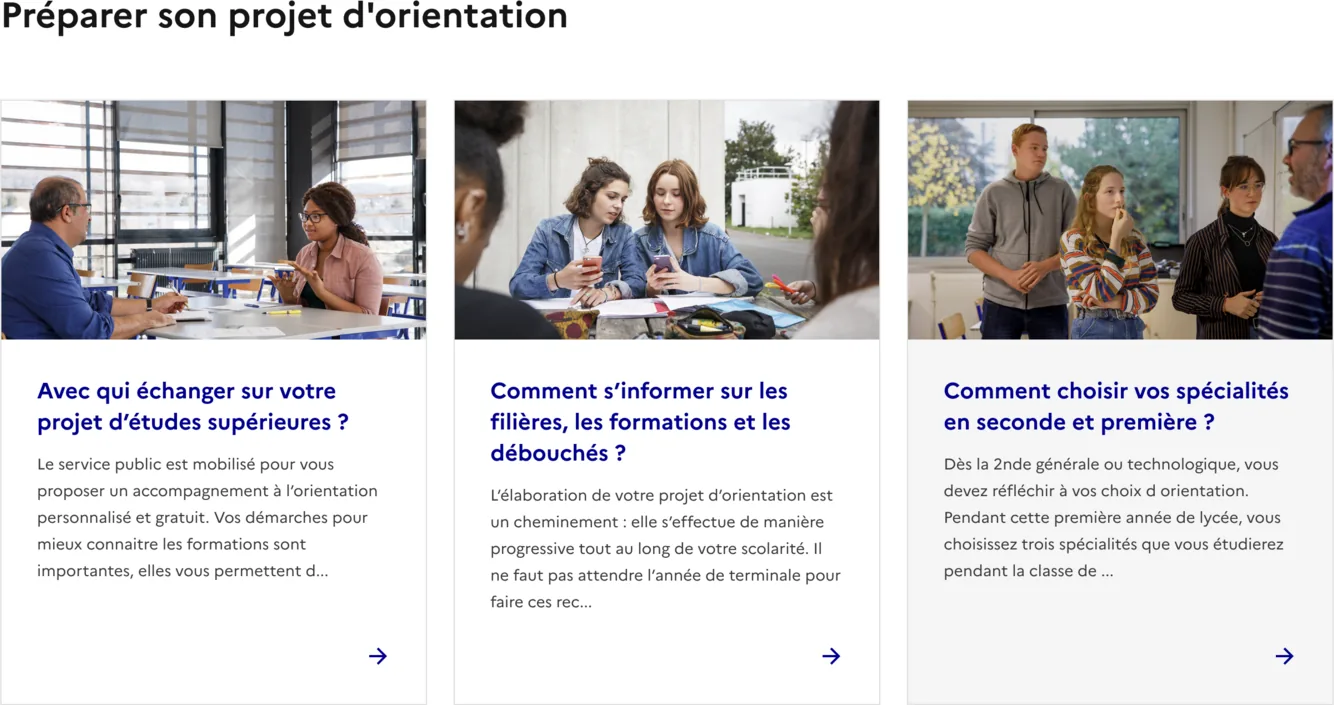
Source: screenshot from the official Parcoursup website (www.parcoursup.fr)
Are there programmes outside Parcoursup?
The number of programmes on the platform grows every year. Yet some admission procedures still sit outside it, notably hospitality schools, certain specialised schools (audiovisual, art and others) and some private schools (journalism, law, communication). This can be because those institutions prefer to run their own admissions (for instance when their calendar does not match Parcoursup’s) or because the diploma awarded is not state-regulated. Do your homework beforehand: being listed on Parcoursup is a guarantee of oversight regarding both the programme and the diploma it delivers.
How Axiom Academic supports international applicants
The academic guidance service launched by Axiom Academic is delivered by a team of independent educational guidance counsellors trained in the key stages of orientation from the start of secondary school, in the expectations of the Parcoursup platform and in the selection processes it involves, such as motivation interviews. Their distinctive strength is a deep understanding of expatriate families: most of them have lived outside France for years themselves.
Axiom Academic’s Parcoursup support is designed above all to take pressure off families, with personalised follow-up at every stage of the calendar and hands-on help writing the essential parts of the application file (the profile sections, the PFM and more). Thanks to their international outlook, our counsellors speak the same language as students educated outside France and can point them towards the right programmes, in France or elsewhere, according to their needs. To discuss your child’s situation, you can contact us at any point in the cycle.
Key takeaways
- Parcoursup is France's national admissions platform, the equivalent of UCAS or the Common App, listing close to 24,000 programmes in 2024
- Unlike UCAS, choices are not ranked: each programme reviews your file without knowing your order of preference
- Three main stages: research from November to January, applications from January to early April, main admission phase from June to July
- Selective programmes hold exams and motivation interviews between April and June, so preparation should start early
- Students outside the AEFE network enter their own records and translate teacher comments, which takes extra time
- Public tuition fees in France remain modest compared with most English-speaking destinations
- Axiom Academic's counsellors, specialists in expatriate families, support applicants at every stage of the Parcoursup calendar